Check what the smart-bulb dimming figure actually describes
Distinguish an app dimming specification from mains-dimmer suitability and the light you will perceive in a room.
Updated:
Read which control the dimming claim refers to
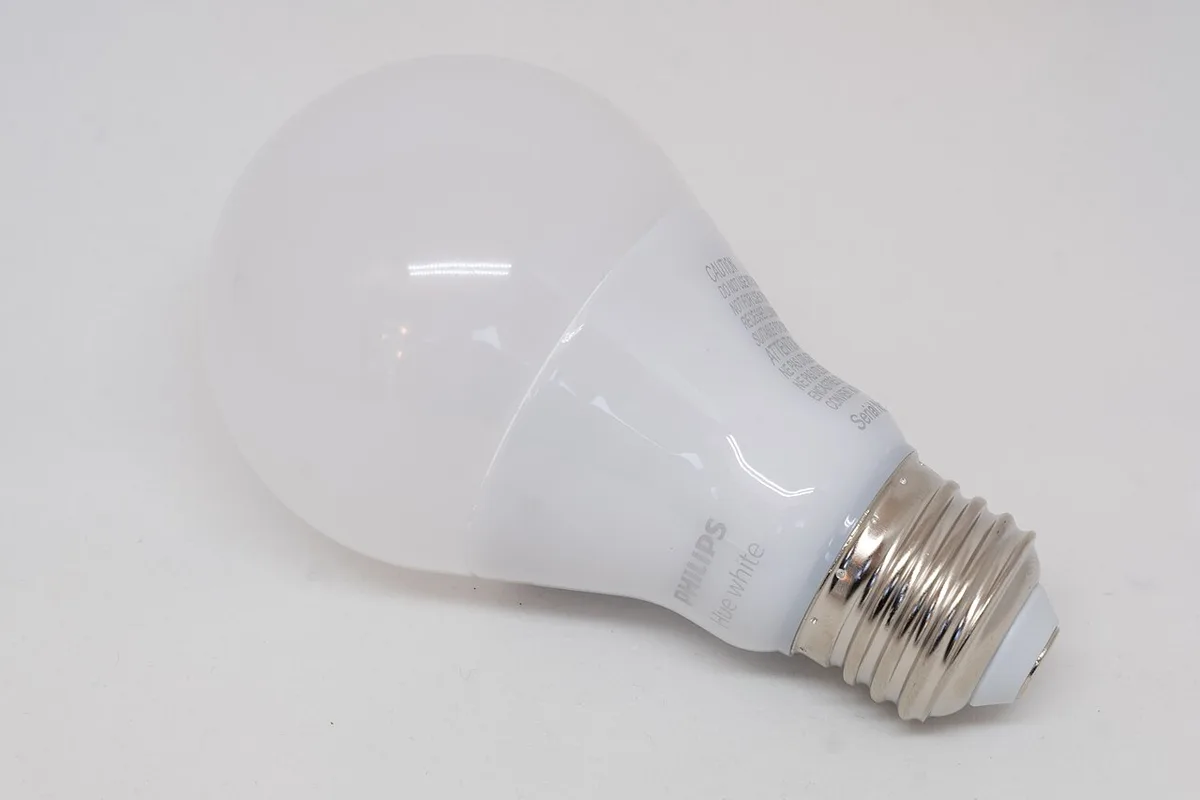
The Australian Hue White A60 E27 model 8720169395268 is advertised as dimming to 5% through the Hue app. That describes a supported control context; it is not a statement that any existing wall dimmer is suitable. A shopper comparing bulbs should record both the dimming claim and the means of control. Do not transfer a feature from a similarly shaped filament lamp, an older white bulb or another model in a shared listing. The archival white-bulb photograph is useful for recognising the physical object, but its appearance does not reveal the current model's electronics or instructions.
Hue AU White A60 E27 1100 model 8720169395268 ?
Keep percentage separate from a measured lumen value
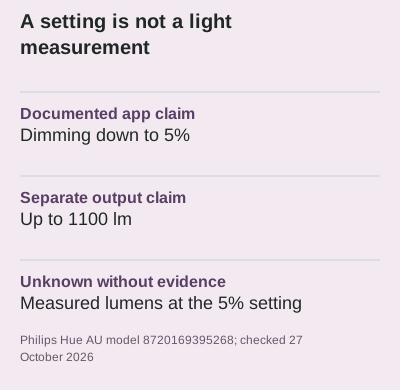
A 5% control description does not, by itself, establish a measured output of exactly 55 lm from a bulb advertised at up to 1100 lm. Multiplying 1100 by 0.05 gives 55 as arithmetic, but the manufacturer statement must explicitly connect the setting to physical output before that becomes a product claim. Control curves, measurement conditions and the meaning of the displayed percentage matter. In a comparison sheet, write the documented minimum setting and maximum advertised output in separate fields. Leave the minimum measured light output unknown if it is not actually documented.
Do not infer power at a dimmed setting
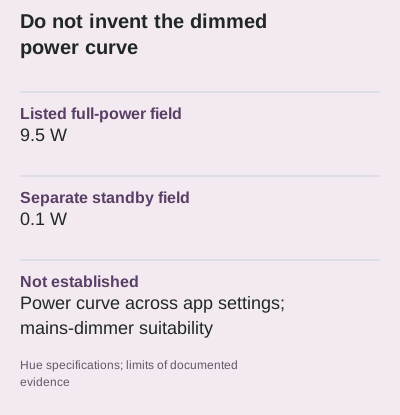
The listed 9.5 W power and 0.1 W standby consumption also do not define every intermediate operating state. Multiplying 9.5 W by a brightness percentage is not a validated power model. If energy consumption at a specific setting is essential to your decision, it needs suitable documentation or a clearly described measurement. Otherwise use a labelled scenario and retain its limitations. This prevents a dimming feature from turning into an invented annual-saving claim. The exact operating conditions should remain visible next to any number used in a later household calculation.
Preserve an ordinary control plan for the room
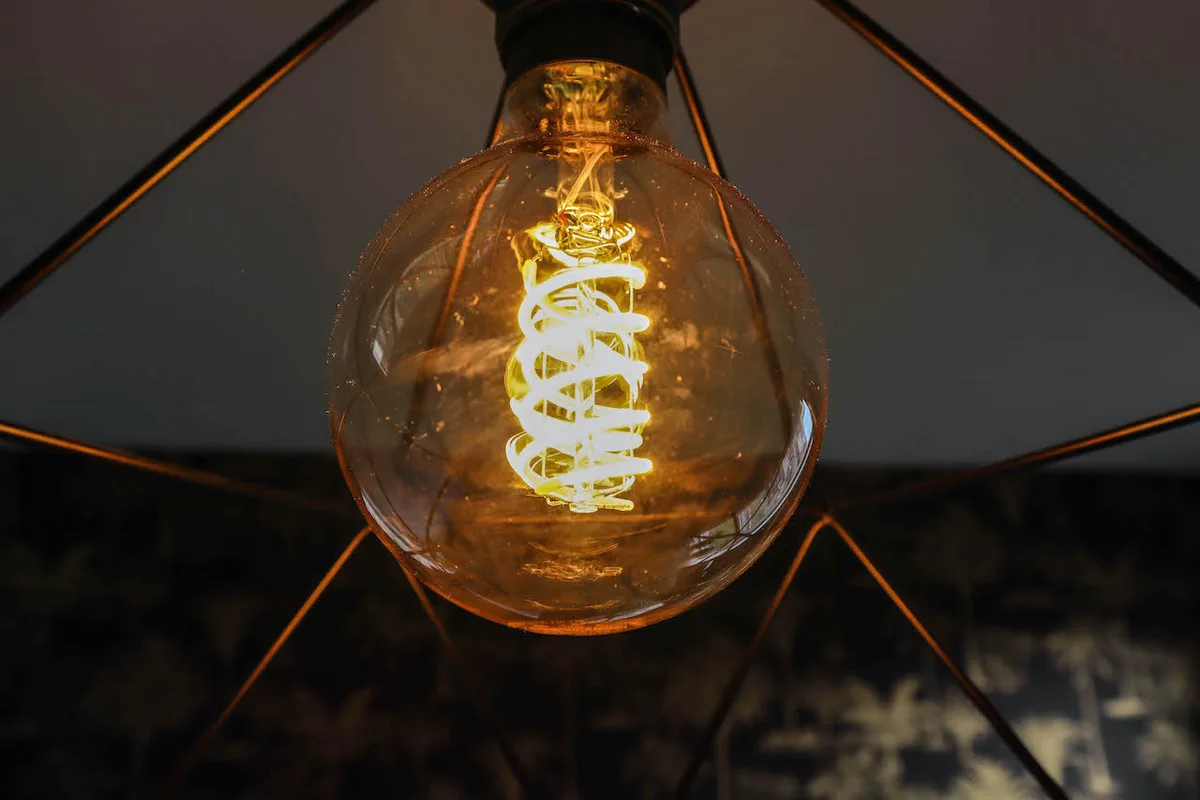
Before purchasing, describe how people will turn the light on, adjust it and stop an unwanted routine. Use the manufacturer's supported controls and actual instructions; do not improvise mains wiring or conceal a wall switch behind a decorative accessory. A lamp's own restrictions still apply even if an app can see the bulb. The filament photograph shows a different light source and shade arrangement, which can alter the perceived effect of a setting. It is not a comparison test of dimming quality, flicker, comfort or colour consistency between products.
Make a small, explicit shortlist
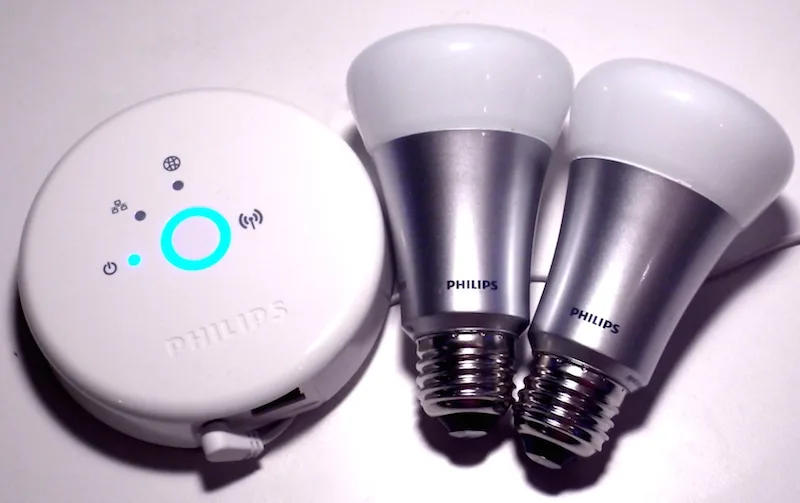
For each candidate, record exact regional model, documented control method, minimum setting description and any unresolved fixture requirements. Keep physical fit separate as well: the example bulb's 62 mm diameter and 112 mm height tell you about its body, not its dimming compatibility. The historical hub-and-bulbs photograph illustrates that controls can involve separate components whose generation matters. Do not assume those old devices remain a supported route for a new purchase. A useful outcome is a shortlist with clear supported features and visible unknowns, followed by the actual current instructions, rather than a universal recommendation based on a percentage alone.
Open official model documentation ?